Solar Incentives for Kansas Businesses
A commercial solar project in Kansas can recover up to about 80% of its installed cost through federal tax credits and depreciation — most of it in the first year. A 30% federal credit stacks with two 10% bonuses and 100% first-year bonus depreciation, and Kansas exempts the system’s added value from property tax for 10 years. The exact mix depends on your address and your tax situation — we model it for your site.
These numbers apply no matter which installer you choose — if you’re still comparing solar companies in Kansas, see our guide to choosing the right one.
Which one applies to you?
People search for the federal solar tax credit as if there were one. There are two — one for businesses and one for homes — and in 2026 only the business credit is still open.
The business credit is open.
If you own a business, a farm, or a public building, the federal clean energy credit still applies — the 30% credit, the two 10% bonuses and the first-year depreciation broken down below. It’s claimed by whoever owns the system, against their own tax position. Owners with no tax bill can take it as cash instead.
See the commercial solar page for how a project comes together, or call and we’ll model your site.
The home credit has ended.
The federal residential solar credit (25D) ended 2025-12-31, so a home system installed today gets no federal credit. Home solar can still pay back on the fundamentals — especially where your utility offers net metering, which lets you offset most or all of your usage with your own production.
We still install home systems. See how home solar works.
30% credit.
100% depreciation.
Up to ~80% back.
A fully qualifying commercial project can recover up to about 80% of its installed cost — most of it in year one. The base 30% credit and two 10% bonuses combine with 100% first-year bonus depreciation. The energy-community bonus is location-specific — it covers much of rural southeast Kansas, but most town centers are excluded — so we check your exact site on the DOE map and model your specific numbers from the assessment. One timing note: the 30% credit and both 10% bonuses apply only to projects placed in service by Dec 31, 2027 — the 100% bonus depreciation isn’t tied to that date.
* Estimate worked from public IRS rules — of project cost, recovered as credits plus depreciation. Your depreciation benefit depends on your tax bracket, and not every site qualifies for both bonuses.
† The 30% credit and both 10% bonuses require the project to be placed in service by Dec 31, 2027; 100% bonus depreciation is a separate, ongoing provision.
SEK Solar provides solar EPC services, not tax advice. The figures on this page are estimates worked from public IRS and Kansas rules; your actual benefit depends on your own tax situation. Confirm the specifics with your CPA or tax advisor before you file.
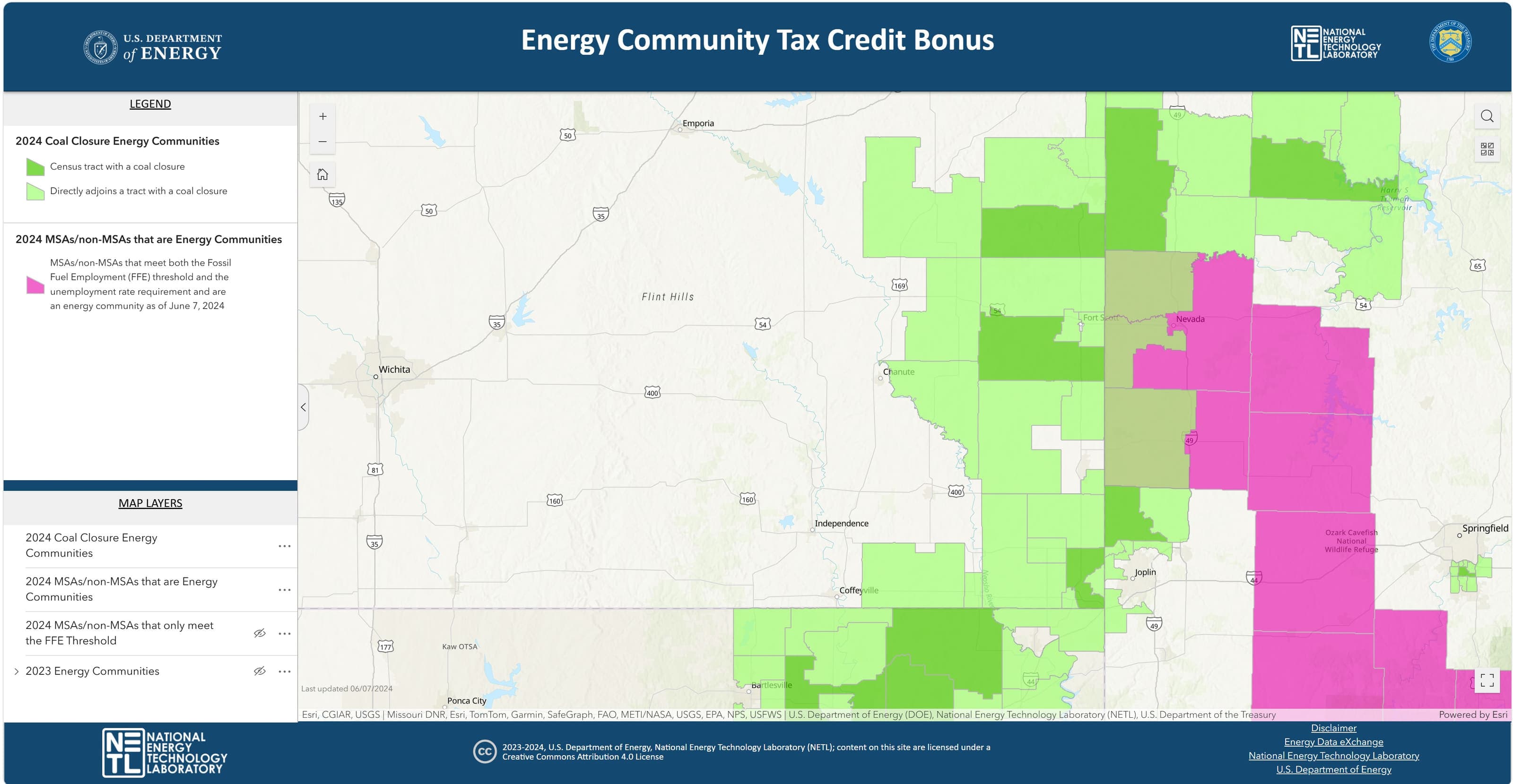
Is your site in the green?
The +10% energy-community bonus covers census tracts tied to coal — where a mine or coal plant has closed, plus the tracts next to them — so much of southeast Kansas qualifies. Green & magenta areas on the map are eligible (unfortunately, most town centers are not).
 Open zoomable DOE map
DOE Map as of 28 June 2026. Click the map to see a zoomable version on the DOE’s site. Eligibility is determined by exact address — we confirm yours during the assessment.
Two more that change the math.
One is a Kansas exemption that runs for a decade. The other lets tax-exempt organizations claim the federal credit as cash.
10-year property-tax exemption
Kansas exempts renewable energy systems from property tax for 10 years. Because it’s an ongoing exemption rather than a year-one credit, it sits outside the federal stack above — but it lowers what you carry on the system for a decade.
Under K.S.A. 79-201 (Eleventh), the renewable-generation equipment is exempt for the 10 tax years after it’s placed in service. Commercial systems file a one-time exemption application with the county / BOTA; it covers the generation equipment, not battery storage.
No tax bill? Take the credit as cash.
Tax-exempt organizations — schools, cities, and nonprofits — can receive the same 30% federal credit (plus any bonuses) as a direct cash payment through elective (direct) pay, claimed after the system is placed in service. It’s the same credit a for-profit would take against taxes, paid out instead as cash.
Filed after in-service; payment follows the return. We’ll walk public-sector owners through the timeline.
If you don’t pay federal income tax, this is how you get the credit.
Schools, cities and nonprofits don’t pay federal income tax, so a tax credit would normally be worth nothing to them. Elective pay — often called direct pay — changes that. The credit is paid out to the organization as cash rather than reducing a tax bill it doesn’t have.
Who this applies to: public school districts and colleges · cities, counties and other units of local government · rural water districts and similar public bodies · 501(c)(3) nonprofits, including churches and hospitals.
What it doesn’t change:you still own the system, and it’s the same 30% credit plus any bonuses a taxable owner would claim. It’s filed on a federal return after the system is placed in service, and the payment follows. The 30% credit and both 10% bonuses still require the project to be placed in service by Dec 31, 2027.
In practice it means a district or a city can build solar on its own budget, without needing a tax-equity partner to make the credit usable. Ask us to model it for your building.
Looking for REAP grants?
If you’ve researched rural solar funding, you’ve probably come across it. Here’s where it stands today.
REAP grants are paused.
The USDA Rural Energy for America Program (REAP) has funded solar for ag producers and rural small businesses for nearly two decades — both through grants and guaranteed loans. With new funding from the Inflation Reduction Act (IRA) the program grew substantially, funding hundreds of new solar installations across the Midwest, including Kansas, Missouri & Oklahoma. However, the current administration is reviewing regulations for solar and wind projects, the REAP program being among them. For that reason, new REAP grant applications are currently on hold, and there is no word on if and when the program will return in a meaningful way.
So we don’t build REAP into your numbers. The federal credits and depreciation above stand on their own — and they’re what make a Kansas solar project pencil out today. If REAP funding does reopen, we’ll flag it for you.